


Something strange is showing up in a lot of marketing dashboards right now.
Organic search traffic is sliding. Someone on the leadership team is nervous about it. Then someone checks the actual pipeline numbers. Revenue is fine. Sometimes it's better than fine.
Here's why: a June 2025 Semrush study looked at over 500 marketing and SEO topics and found that people who arrive on a website through AI search (ChatGPT, Perplexity, Google's AI Overviews) convert at 4.4 times the rate of people who arrive through a regular Google search. Same website. Same offer. Four times the conversion rate, from a channel most teams aren't even tracking yet.
That's not a rounding error. That's a budget conversation.
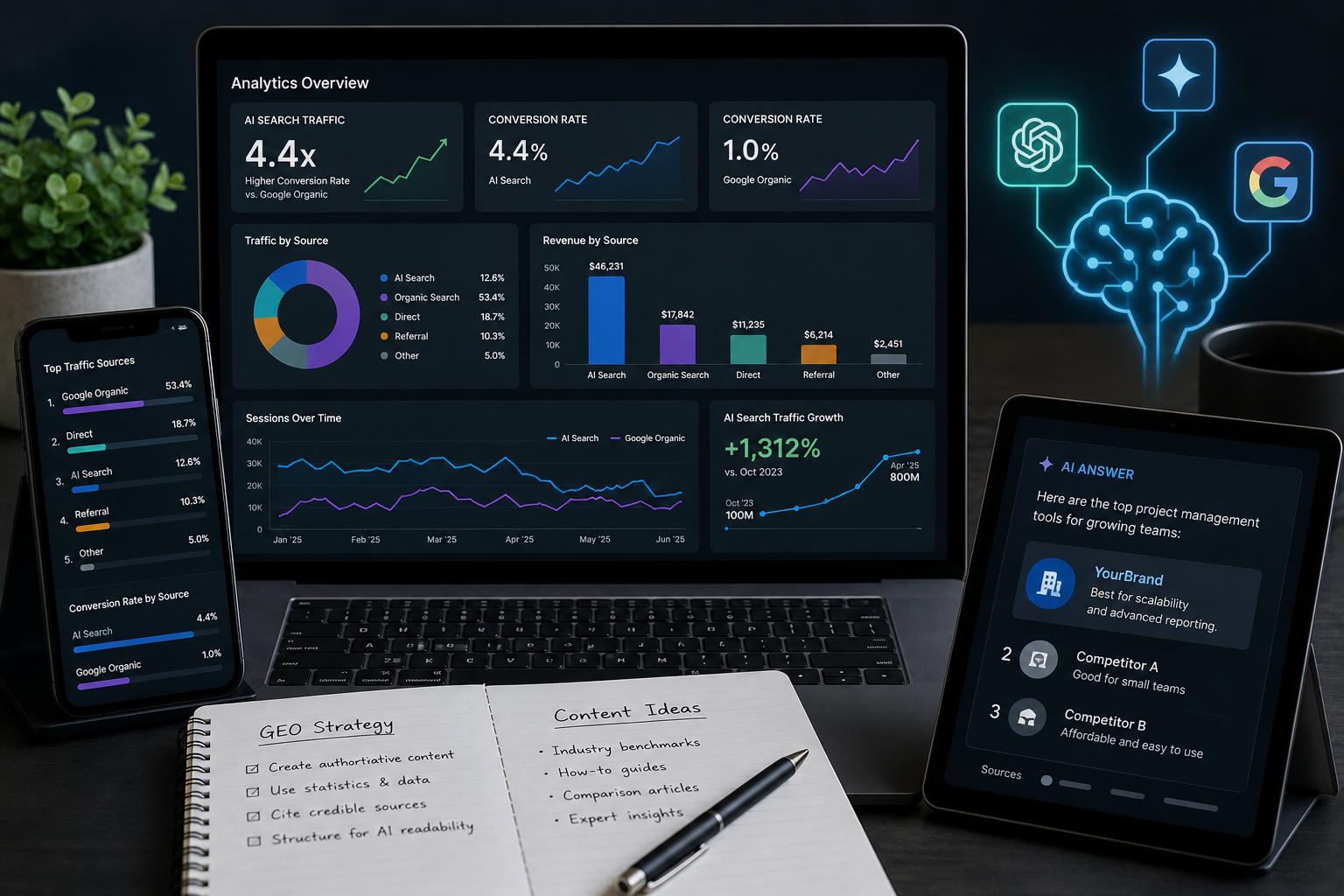
AI search traffic converts at 4.4x the rate of regular organic search — but most teams aren't tracking it yet.
What "AI Search" and "GEO" Actually Mean
Quick definitions, because the jargon trips people up fast.
AI search is any search experience where you get a written answer instead of (or alongside) a list of links: ChatGPT, Perplexity, Claude, Google's AI Overviews.
GEO stands for Generative Engine Optimization. It's the practice of writing your content so AI tools can find it, trust it, and quote it.
The simplest way to think about the difference: SEO gets you ranked. GEO gets you recommended, inside someone else's answer, before a buyer ever lands on a search results page at all.
How an AI Search Answer Actually Gets Built
When someone asks ChatGPT a question, it isn't searching the whole internet live. It pulls a small handful of sources, usually three to five, and stitches them into one answer. Then it decides, source by source, whether to actually link out to you.
That decision is the whole game.
Semrush found that half the links inside ChatGPT's answers point to real business websites, not just media coverage or forum posts. The model already considers plenty of business sites trustworthy enough to send people to directly. The same research found people click those links almost twice as often as they click a regular Google result.
This part matters: by the time someone clicks through from an AI answer, they've already been vetted by the AI itself. They didn't stumble onto you. They were recommended to you, the way a friend recommends a restaurant after already checking the menu for you.
That's the entire reason the 4.4x number exists.
Why the Lift Happens (and Who Actually Gets It)
This is the part that usually gets oversimplified, so slow down here.
The lift tracks how much homework someone does before buying, not whether the business is B2B or B2C.
If you're choosing enterprise software, hiring an agency, picking a healthcare provider, comparing financial advisors, or even shopping for a car or a mattress, you're probably researching for a while before deciding. AI tools are good at that kind of decision: they compare options, explain tradeoffs, and point you toward a few credible ones. By the time you click through to one of those sites, you've already done the comparison. You're not browsing anymore. You're deciding.
That's a very different visitor than someone three tabs deep into Google, still weighing five options at once.
Why you should care: if your business involves any real research phase before someone buys, which describes most businesses that aren't selling something on impulse, treat your AI-referred visitors as warmer than your average organic click. The data says they are, often by a wide margin.
The One Big Exception
This is where it gets specific. Slow down here before moving the whole budget.
A separate study looked at 973 e-commerce sites, together generating $20 billion a year in revenue, over a full 12 months. It found the opposite result. ChatGPT referral traffic converted about 13% worse than regular organic search for these purchases. ChatGPT traffic was also tiny in that dataset: about 0.2% of all sessions, roughly 200 times smaller than Google search traffic.
Two things explain the gap.
- In e-commerce, plenty of "organic search" traffic is really brand loyalty wearing a disguise. Someone who types "J.Crew" into Google instead of just typing the web address still counts as an organic visitor, and they were always going to buy. AI search doesn't get that same free credit.
- AI tools tend to point people toward review sites and forums (Wirecutter, Reddit) for product questions, not the store itself. If someone buys later, the credit for that sale often lands somewhere else entirely.
The split runs along research versus impulse, not B2B versus B2C. If people grab what you sell without thinking twice, AI search probably isn't your highest-converting channel yet. If people spend real time deciding before they buy from you, in any industry, it probably already is.
The Cost of Ignoring This
Most analytics tools still lump ChatGPT and Perplexity traffic into a bucket called "Other" or "Direct". A lot of teams are sitting on their best-converting channel and don't even know it's there.
ChatGPT went from 100 million weekly users in October 2023 to 800 million by April 2025. That's how a huge share of your customers now start their research, and most reporting dashboards haven't caught up to notice.
Semrush's own forecast has AI search matching traditional search in economic value by the end of 2027 for marketing-related searches, and that timeline tends to move earlier, not later, as AI Overviews and AI Mode become Google's default experience rather than the exception.
What to Actually Do About It
Three things. None require a department reorg.
- Pull AI traffic out of "Other" in your analytics, even roughly. You can't manage a number you've never looked at on its own.
- Write content that's easy to quote. Use specific numbers and name your sources. A vague opinion piece gives an AI nothing it can confidently lift and repeat.
- Stop judging success by total traffic alone. A handful of AI-referred visitors converting at 4x the normal rate can be worth more, in real dollars, than a much bigger pile of low-intent clicks. Put revenue per visitor on the dashboard, right next to visitor count, not buried underneath it.
Quick Questions, Straight Answers
Does AI search traffic really convert better than regular search traffic?
For purchases that involve real research, like software, professional services, healthcare, or big-ticket items, the answer is yes. A June 2025 Semrush study found AI-referred visitors converting at 4.4x the rate of regular organic visitors. For quick, transactional e-commerce purchases, a separate study of 973 sites found the opposite: regular search outperformed AI referrals by about 13%.
Why does it work better for some businesses than others?
It comes down to how much research someone does before buying. AI tools shine when buyers compare, weigh tradeoffs, and want a recommendation. That covers most B2B, healthcare, finance, and big-ticket purchases. For quick impulse buys, regular search (often really just brand-name searches in disguise) still wins.
How do I even track this in my own analytics?
Most platforms won't separate it automatically. ChatGPT and Perplexity referrals usually land under "Other" or "Direct" traffic. Build a dedicated segment based on the referral source (chat.openai.com, perplexity.ai, and similar) to see how that traffic actually converts.
Why SageGridLab
GEO only works as a revenue channel if Marketing is doing its real job: proving the strategy converts, not just publishing more of it. We've watched plenty of agencies treat "AI search optimization" as a content-volume game: more posts, more keywords, the same blind spot on attribution. That's the trap. You can write the most quotable content in your industry and still have no idea it's working if nobody built the measurement underneath it.
We don't hand you a content calendar and call it a strategy. We build the attribution model first, so every piece of GEO content has a number attached to it before it ever ships.
Talk to SageGridLab about turning your AI search traffic into a tracked revenue line
"Bottom line: The cost here isn't 'we missed a trend'. It's 'someone else got their content cited and trusted by AI before we did, and now they're getting introduced to our future customers while we're not even in the conversation'."