


Open your banking app to check a balance. Switch to a delivery app for lunch. Switch again to tell your team it's on the way. Switch once more to book a ride to the client meeting.
Four apps. Four logins. And you still haven't done anything. WeChat's 1.4 billion monthly users already do without leaving a single app: pay an electric bill, message a doctor's office, split a dinner bill, hail a cab, top up a phone plan. Tencent's own numbers put nearly a billion of those users inside WeChat Pay and close to 950 million using its mini-programs every month. Several errands, one login, all day.
That's the pitch behind super-apps: one login, every errand.
That's appealing, obviously. The harder question is whether it works outside the markets that built it, and what that means for a business rather than a user.
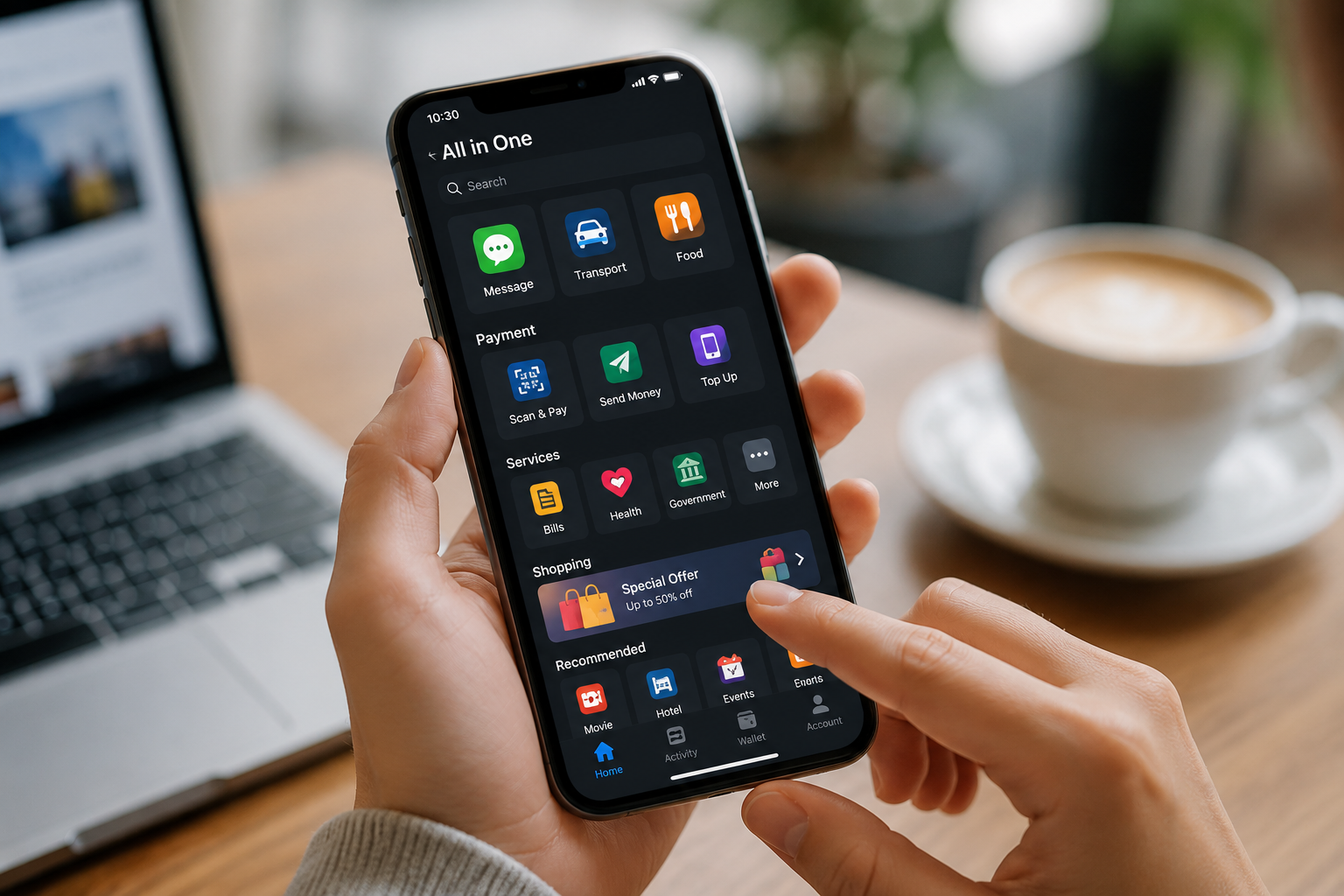
The super-app trend: one login, every errand.
What Exactly Is a Super-App?
What it means: One mobile platform that bundles services normally split across separate apps (messaging, payments, shopping, rides) under a single account.
WeChat is the reference case.
Tencent launched it as a messaging app in 2011 and turned it into the operating system for daily life in China. Grab did the same for Southeast Asia. In the Middle East, Careem (now Uber-owned) runs the same playbook across rides, delivery, and payments. That's directly relevant if you're building for a UAE audience, where the habit is already forming.
The model travels well past Asia and the Gulf. Indonesia's GoTo Group runs it through Gojek: ride-hailing, food delivery (GoFood), and a payments arm, GoPay, that processed over 500 million transactions in a single month in 2025. Roughly half of Indonesia's adults are unbanked, so GoPay's transaction history doubles as the credit file a traditional bank would otherwise demand. Most of GoPay's loans now originate inside the Gojek and GoPay apps themselves. In Latin America, Rappi built the same loop from the other direction: founded in Bogotá in 2015 as a courier app, it now runs grocery, pharmacy, and travel booking alongside its own wallet, RappiPay, across nine countries.
| Persistence Market Research puts the global super-app market at roughly $155 billion in 2026, growing to $838 billion by 2033, with payments accounting for close to a third of that revenue. |
Why the West Still Doesn't Have One
Three structural reasons, not just competitive ones. The EU's Digital Markets Act and GDPR restrict the data centralization a true super-app needs. Card networks were already entrenched before China leapfrogged to mobile payments. And app-switching is low-friction in the West, so the pain WeChat solved in 2011 barely registers here.
That hasn't stopped attempts. X's XChat went into iOS public beta in March 2026, explicitly aimed at "everything app" status. PayPal, Block's Cash App, and Klarna are building "super-app-lite" platforms from the financial-services side outward instead of the messaging side in.
Across our US, Canada, and UAE client base, we keep seeing the same decision point: businesses assume they need to pick a side of this trend before they've asked which side actually applies to their market.
Build Your Own, or Build Inside One?
For almost every business, the answer is the second. Building daily-use behavior from scratch takes years and serious capital. The faster path is becoming the embedded feature inside a platform that already has that behavior. Klarna sits inside checkouts. Stripe powers payments behind storefronts that never mention it.
About two-thirds of super-app users prefer in-app financial services over switching to a separate banking app. People are choosing convenience over loyalty to your app.
Before you commit, name the trade-off: platform dependency. A fee change or feature deprecation on someone else's platform can hit your revenue overnight, and you don't get a vote.
Three terms you'll hit fast:
- An API is the connection that lets one app plug into another's wallet.
- A mini-program is a lightweight app-within-an-app, the WeChat format now copied by Alipay and Toss.
- BNPL (Buy Now, Pay Later) is the installment option embedded at checkout, the core of Klarna's business.
The Bottom Line
Super-apps are already a couple-hundred-billion-dollar category, and GoTo and Rappi show the model travels well beyond the markets that built it. The real question is whether your business plans to be a passenger on one of these platforms, or keeps waiting for a Western WeChat that GDPR and entrenched card networks may never let exist.
"This is exactly where Digital Alchemy earns its keep. We don't treat platform strategy, payments integration, and customer experience as separate vendor conversations competing for budget. Engineering is the substrate, design is the reaction, marketing is the catalyst. And because we work across US, Canadian, and UAE markets under one methodology, we've already mapped how this build-vs-embed decision plays out across three very different regulatory regimes, something a single-market agency hasn't had to figure out yet."
Talk to SageGridLab about where your business fits in the
all-in-one shift
Frequently Asked Questions
Is there a US or European super-app yet?
Not fully. PayPal, X, and Klarna are building "super-app-lite" platforms, two or three bundled services around a core product. Regulation and entrenched payment infrastructure make a true WeChat-style platform unlikely in the West short term.
Should my business build its own super-app?
For almost everyone, no. Integrating into an existing high-frequency platform through an API or embedded feature gets you in front of users faster and cheaper than building the habit yourself.
Closing Line: The habit is the asset. Whoever owns it decides which other apps are even necessary. That's the calculation worth running before a competitor runs it first.